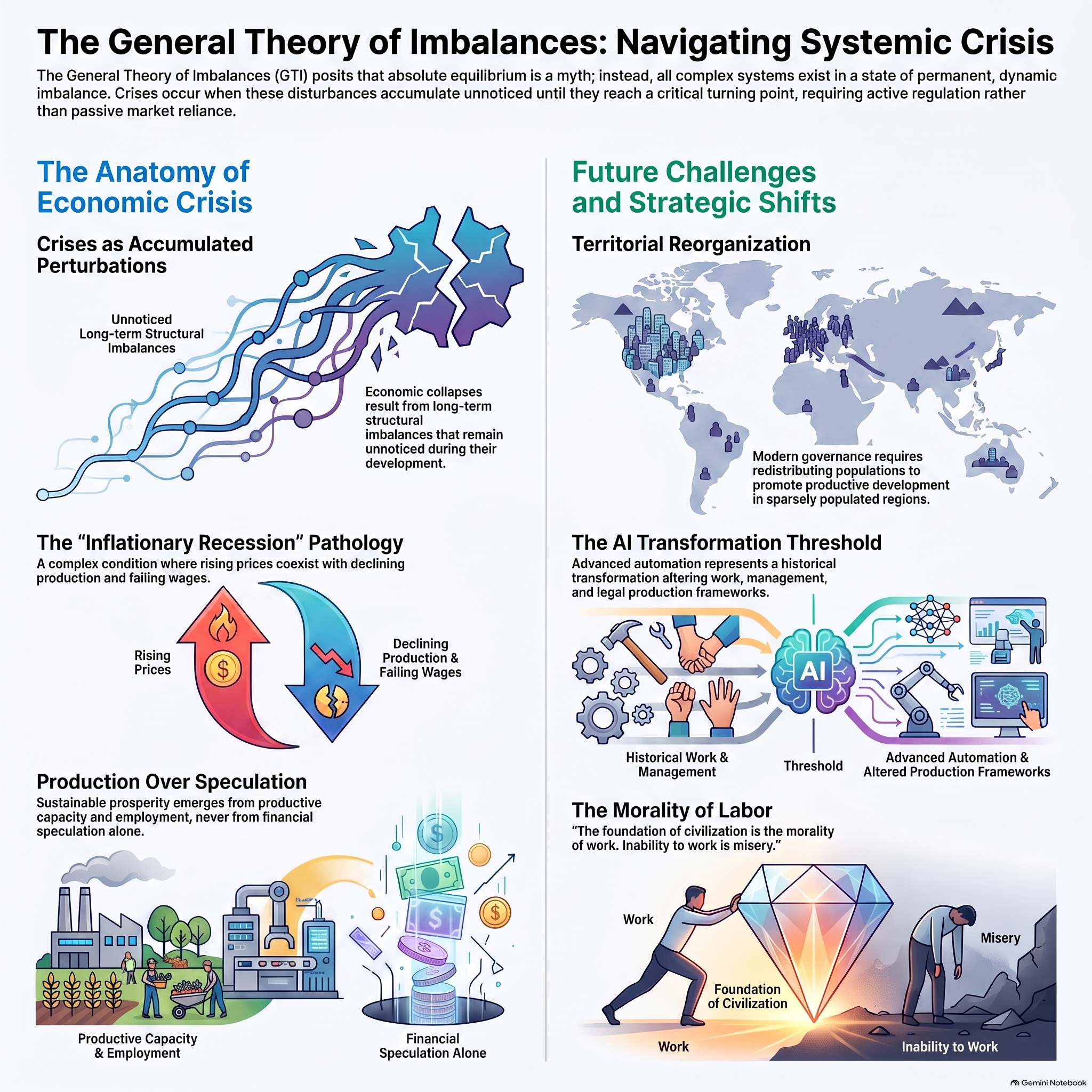
The political, social, and economic anarchy that increasingly characterizes the contemporary world leads humanity toward profound disorder and widespread frustration. Such conditions generate poverty, intolerance, and ultimately the horrors of war. One must therefore recognize that whoever launches the first nuclear strike may unleash the greatest imbalance in human history: the Global Holocaust of our Planet.
Néstor Jorge Bugallo
PROLEGOMENA
My earliest understanding of the concept of imbalance originated from reading a remarkable book that I found in the library of my grandfather, affectionately known as «Goyo.» I still preserve that volume in my personal library as one of my most valuable references.
The work is entitled Economic Studies: An Interpretation of the Political History of Argentina and South America, published in Buenos Aires by La Cultura Argentina in 1916. My grandfather purchased the book at Avenida de Mayo 646, Buenos Aires.
While reading Alberdi’s work, I gradually came to understand that what history commonly describes as political or economic crises are, in reality, the consequences of multiple forms of imbalance generated by human actions. At that early stage I perceived these ideas not through rigorous scientific reasoning but through intuition, an intuition that would later become the foundation of decades of research.
Juan Bautista Alberdi argued that the recurring crises affecting Argentina originated from numerous forms of political, institutional, social, and economic imbalance. Among the factors he identified were poor government administration, inadequate public leadership, uncontrolled indebtedness, speculative behavior, misguided immigration policies, excessive luxury, and other structural deficiencies that prevented the harmonious development of the nation.
Although several of Alberdi’s nineteenth-century views are today historically conditioned, particularly those concerning European immigration and demographic composition, his diagnosis of the structural causes of Argentina’s recurring crises remains remarkably insightful.
I first encountered these ideas around 1950 while attending the General San Martín School of Commerce in La Plata. Since those years I have retained the conviction that economic crises represent the culmination of continuous imbalances that progressively accumulate until reaching a critical turning point capable of reversing entire economic cycles.
For Alberdi, these crises resulted primarily from failures in government administration rather than from unavoidable economic destiny. His analysis connected constitutional organization, political institutions, immigration, production, public finance, economic cycles, and national development into a coherent interpretation rarely equaled in Argentine economic literature.
One of Alberdi’s reflections profoundly influenced my subsequent work:
«The foundation of civilization is the morality of work. Everything that seeks success without labor constitutes immorality. To live without working is among the greatest of moral failures. The inability to work is the principal source of misery.»
This principle remains valid today.
Economic activity should fundamentally serve society rather than speculative interests. Social stability represents one of the highest responsibilities of public leadership.
GOVERNING IS POPULATING
Among Alberdi’s most influential concepts stands his famous maxim:
«To govern is to populate.»
Within today’s context this statement acquires renewed significance.
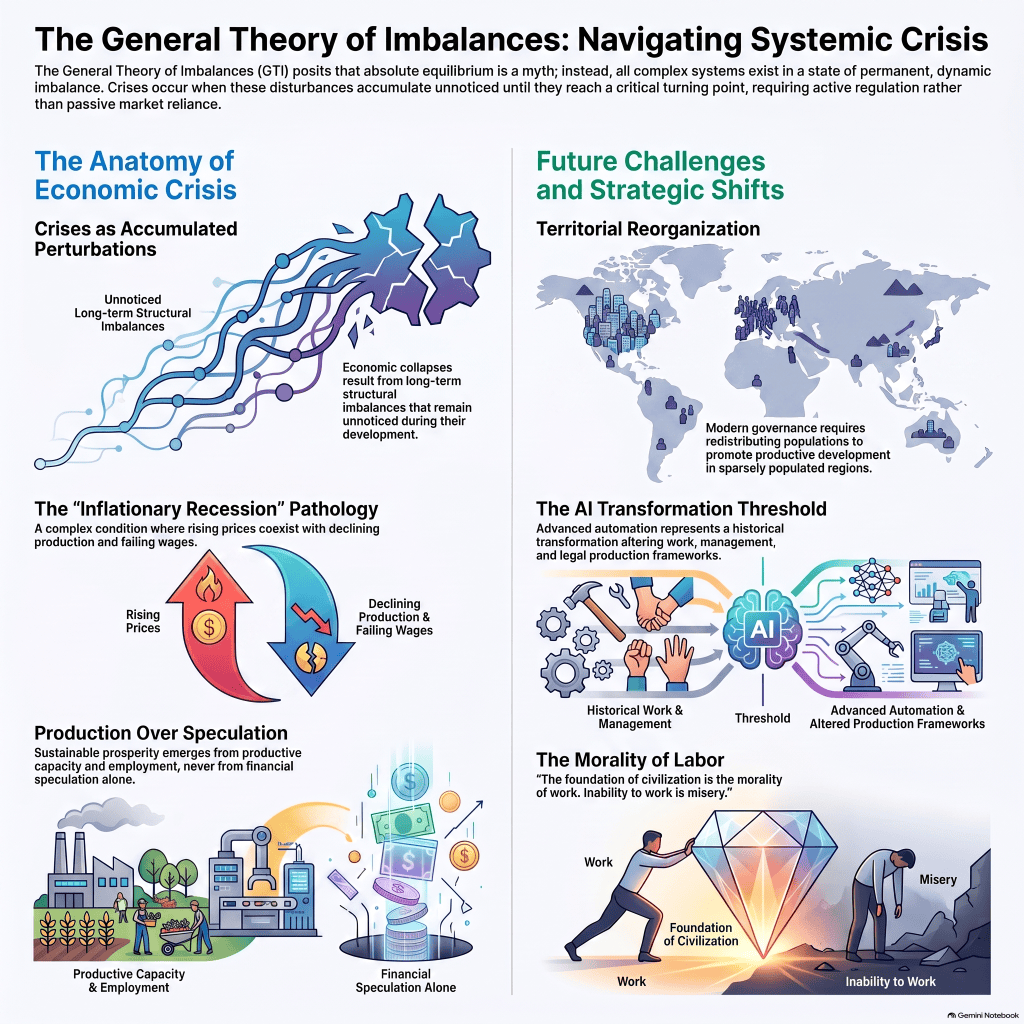
Argentina now faces a demographic imbalance different from that of Alberdi’s time. Rather than merely attracting immigrants, the country must also redistribute its own population rationally by promoting productive development in sparsely populated regions while reducing structural poverty concentrated in highly urbanized areas.
Such territorial reorganization should encourage productive employment, regional industrialization, agricultural expansion, and export-oriented development. At the same time, immigration continues to represent a valuable component for sustaining long-term national growth whenever it is integrated into coherent development policies.
THE NATURE OF ECONOMIC CRISES
Alberdi quoted John Stuart Mill, who observed that:
«Crises are a new and obscure phenomenon. Like modern credit and modern commerce, they are evils inseparable from their benefits.»
This reflection remains extraordinarily relevant.
Today excessive financial leverage, compound interest applied without economic rationality, declining purchasing power, insufficient productive investment, speculative financial markets, corruption in public procurement, uncontrolled capital flight, and illicit financial operations continue generating new forms of structural imbalance.
Alberdi asked:
«What is an economic crisis?»
His answer was concise:
«A disease of the purse that simultaneously affects all members of a nation’s society.»
From the perspective developed in the General Theory of Imbalances, an economic crisis may be interpreted as the systemic manifestation of accumulated perturbations that progressively erode production, employment, purchasing power, investment, and institutional stability until the entire economic structure enters a state of generalized dysfunction.
Economic crises therefore should not be understood as isolated events but rather as the visible consequences of long-term structural imbalances whose causes frequently remain unnoticed while they are developing.
THE MORAL DIMENSION OF PUBLIC ADMINISTRATION
Alberdi repeatedly insisted that one of the principal causes of national decline was the irresponsible use of borrowed capital.
He wrote:
«No one spends easily what has been earned through personal labor; yet everyone spends another person’s money with remarkable ease.»
Banks lend because lending generates profit.
Governments borrow because borrowing postpones political costs.
Citizens ultimately bear the consequences.
History repeatedly demonstrates that excessive indebtedness, speculative finance, and deficient public administration gradually undermine productive capacity and eventually transform temporary financial prosperity into generalized social impoverishment.
This historical lesson remains one of the central pillars upon which the present work is built.
Inflationary Recession, Structural Imbalances, and the Limits of Conventional Economic Policies
The persistent deterioration of production, employment, purchasing power, and investment cannot be understood solely through the traditional concepts of inflation or recession considered separately. Contemporary economies increasingly experience a more complex pathological phenomenon in which inflation coexists with productive contraction, declining real wages, reduced consumption, and a generalized weakening of economic activity.
This condition, which I have described for decades as inflationary recession, represents one of the clearest manifestations of systemic imbalance.
It is not merely a monetary phenomenon. Rather, it is the result of the interaction of numerous disturbances affecting production, finance, public administration, international trade, taxation, technological development, and the social organization of labor.
Many contemporary policymakers continue to assume that monetary contraction alone is sufficient to eliminate inflation. Such an approach overlooks the structural complexity of modern economies.
Reducing the money supply without simultaneously stimulating productive activity, investment, employment, and technological development merely deepens recession while transferring the economic burden to households and productive enterprises.
History repeatedly demonstrates that prolonged economic adjustment based exclusively on fiscal contraction and monetary restriction eventually produces social deterioration, declining investment, industrial stagnation, and increasing structural poverty.
The imbalance therefore becomes cumulative.
Each corrective action generates new disturbances whose consequences extend throughout the entire economic system.
The Illusion of Self-Regulating Markets
One of the greatest misconceptions of contemporary economic doctrine consists in believing that markets automatically restore equilibrium without institutional guidance.
Experience suggests otherwise.
Markets respond to incentives, expectations, uncertainty, information asymmetries, political instability, technological change, and international pressures.
They are not autonomous mechanisms capable of correcting every structural distortion.
When governments withdraw completely from their essential regulatory functions, speculative dynamics frequently replace productive investment.
Imports may temporarily reduce prices while simultaneously destroying domestic production.
Financial profitability often replaces industrial profitability.
Employment declines.
Consumption contracts.
Investment weakens.
Public infrastructure deteriorates.
Far from restoring equilibrium, these processes amplify systemic imbalances.
The General Theory of Imbalances therefore rejects both excessive state intervention and absolute economic laissez-faire.
Every complex society requires dynamic regulation capable of maintaining productive, financial, technological, and social stability while preserving individual freedom.
Production as the Foundation of Economic Stability
Throughout history, sustainable prosperity has never resulted exclusively from financial speculation.
Rather, it has emerged from productive capacity.
Production generates employment.
Employment generates income.
Income sustains consumption.
Consumption finances production.
This continuous interaction constitutes one of the principal feedback mechanisms governing modern economies.
Whenever production weakens, the entire economic structure gradually loses its capacity for self-sustainability.
Consequently, the principal objective of economic policy should not simply consist of balancing fiscal accounts but of preserving the productive capabilities of society.
Public finances, monetary policy, taxation, investment, education, infrastructure, scientific research, and technological innovation must operate as coordinated components of an integrated system.
Economic equilibrium cannot be reduced to accounting balance.
It must instead be understood as the dynamic stability of an entire productive civilization.
Artificial Intelligence and the Future Organization of Society
Human civilization is entering a historical transformation comparable to the Industrial Revolution.
Artificial Intelligence, autonomous robotics, advanced automation, and cybernetic systems are progressively altering the nature of work, management, production, and decision-making.
Future enterprises may operate under the supervision of intelligent systems capable of performing administrative, financial, engineering, and logistical functions with minimal human intervention.
This transformation raises entirely new questions.
Who will own companies administered primarily by Artificial Intelligence?
Who will receive the economic benefits generated by autonomous production?
How should taxation evolve when intelligent systems replace large sectors of human labor?
Could autonomous industrial organizations eventually require legal frameworks governing interactions between human institutions and artificial agents?
These questions extend far beyond economics.
They involve philosophy, law, political science, ethics, sociology, cybernetics, and systems theory.
They represent emerging fields where future forms of imbalance may develop.
Consequently, the General Theory of Imbalances must also evolve to incorporate these unprecedented realities.
Political Disorder and National Decline
History repeatedly confirms that societies rarely collapse because of a single catastrophic event.
Decline generally results from the prolonged accumulation of multiple unresolved disturbances.
Administrative inefficiency.
Institutional instability.
Corruption.
Excessive indebtedness.
Speculation.
Declining education.
Weak scientific development.
Political polarization.
Loss of productive capacity.
All these elements interact progressively until systemic instability reaches a critical threshold.
Juan Bautista Alberdi clearly perceived this relationship more than a century ago when he argued that Argentina’s recurrent crises originated primarily in poor government administration rather than in unavoidable economic destiny.
His diagnosis remains remarkably relevant.
Modern crises continue to emerge from the interaction between institutional weaknesses and structural economic imbalances.
The Nation as a Living Organism
A useful analogy may be drawn between the national economy and the human body.
When a patient suffers from chronic malnutrition, circulatory failure, immune deficiency, and progressive organ deterioration, reducing nutrition cannot restore health.
On the contrary, further deprivation accelerates systemic collapse.
Similarly, an economy experiencing declining production, falling investment, shrinking consumption, deteriorating infrastructure, and increasing poverty cannot recover solely through additional contraction.
The productive organism must receive the resources necessary for regeneration.
Public investment.
Private investment.
Technological modernization.
Scientific research.
Education.
Infrastructure.
Institutional confidence.
These represent the economic equivalent of restoring circulation, nutrition, and physiological balance within a living organism.
The objective is not static equilibrium.
Rather, it is the continuous regulation of dynamic imbalances that sustain healthy systemic functioning.
The Birth of an Intellectual Journey
The reflections inspired by Alberdi gradually led me beyond economics.
I began asking whether the concept of imbalance might possess a broader scientific meaning applicable not only to economic systems but also to biology, physics, chemistry, psychology, sociology, political science, geology, astronomy, and philosophy.
Could there exist universal principles governing the emergence of imbalance across all organized systems?
This question became the starting point of decades of interdisciplinary investigation.
Over time I examined contributions from physicians, physicists, chemists, engineers, economists, psychologists, mathematicians, philosophers, historians, cyberneticists, and systems theorists.
Each discipline offered valuable insights.
Yet each generally examined imbalance only within its own specialized domain.
What appeared to be missing was a unified theoretical framework capable of integrating these diverse perspectives into a single conceptual structure.
The search for such a framework ultimately gave rise to what I have called the General Theory of Imbalances (GTI).
The Intellectual Genesis of the General Theory of Imbalances
The development of the General Theory of Imbalances (GTI) did not emerge from a single discipline, nor was it the product of an isolated intellectual effort. Rather, it evolved gradually through decades of interdisciplinary study, professional experience, philosophical reflection, and dialogue with scholars from diverse scientific fields.
As my research progressed, I became increasingly convinced that imbalance was not merely an occasional disturbance affecting isolated systems. Instead, it appeared to constitute one of the fundamental principles governing the evolution of nature, society, and human knowledge itself.
This conviction encouraged me to broaden my investigations beyond economics into biology, medicine, chemistry, physics, cybernetics, systems theory, psychology, philosophy, mathematics, and the emerging sciences of complexity.
Each discipline illuminated a different aspect of a much larger reality.
Pierre Vendryes and the Biological Foundations
A decisive turning point occurred when I discovered Pierre Vendryes’ remarkable work Towards a Theory of Man (Vers une théorie de l’Homme).
While searching unsuccessfully through bookstores for literature dealing specifically with imbalance, a bookseller suggested this work, believing it might relate to my interests.
His recommendation proved invaluable.
Within Vendryes’ book I encountered concepts that would later become essential components of my own theoretical framework.
Among them were:
- Determinism and indeterminism.
- Randomness and probability.
- Biological autonomy.
- Physical models applied to living systems.
- Experimental verification.
- Interaction between organisms and their environments.
Vendryes, drawing extensively upon the physiological research of Claude Bernard, emphasized that living organisms continuously regulate themselves through dynamic interactions with external conditions.
This idea profoundly influenced my own understanding.
Life does not exist because equilibrium is maintained.
Life exists because continuous regulatory processes compensate for permanent imbalances.
Probability, Uncertainty, and Human Decision
Another concept that profoundly impressed me appears in Vendryes’ discussion of moral probability.
Human decisions rarely arise from absolute certainty.
Instead, individuals continually evaluate uncertain possibilities, subjective expectations, ethical considerations, accumulated experience, and incomplete information.
Consequently, human behavior cannot be fully explained through deterministic laws alone.
Probability itself becomes one of the fundamental mechanisms governing historical evolution.
Random events, apparently insignificant at first, may progressively generate transformations whose consequences become irreversible.
These reflections later became central components of the General Theory of Imbalances.
Perturbations rarely announce themselves dramatically.
They often begin as almost imperceptible fluctuations.
Only later do they evolve into major structural transformations.
Dialogue with Professor Ernesto Borga
During these years I had the privilege of discussing many of these emerging ideas with Professor Ernesto Borga, philosopher, jurist, and former Director of the Institute of Philosophy at the Faculty of Economic Sciences of the National University of La Plata.
Professor Borga had introduced generations of students to Kantian philosophy, Husserlian phenomenology, epistemology, and philosophical methodology.
When I presented to him my early ideas concerning imbalance, our conversations gradually evolved into extensive philosophical discussions.
He recognized that my approach departed from traditional philosophical interpretations by proposing that instability, rather than stability, constituted the normal condition of existence.
During one of our last meetings, Professor Borga encouraged me to continue developing these ideas.
His confidence represented an important intellectual stimulus that strengthened my determination to pursue this research.
From Economics to a Universal Theory
As my investigations expanded, imbalance ceased to appear merely as an economic phenomenon.
Instead, similar dynamic principles became visible throughout numerous scientific disciplines.
Medicine described physiological regulation.
Physics investigated irreversible processes.
Chemistry revealed oscillating reactions.
Biology analyzed adaptation.
Psychology studied behavioral change.
Cybernetics explained feedback mechanisms.
Systems theory explored self-organization.
Complexity science examined nonlinear evolution.
Although each discipline employed different terminology, all appeared to describe variations of the same underlying phenomenon.
This realization gradually suggested the possibility of constructing a genuinely interdisciplinary theory capable of integrating these apparently separate fields.
The concept of imbalance became the unifying principle.
The Influence of Ilya Prigogine
One of the most decisive influences on the maturation of my thinking came from the work of Ilya Prigogine, particularly his book Order out of Chaos, co-authored with Isabelle Stengers.
Prigogine demonstrated that systems operating far from thermodynamic equilibrium are capable of generating new forms of order through irreversible processes.
This conclusion profoundly transformed twentieth-century science.
Classical physics had traditionally associated order with equilibrium.
Prigogine demonstrated precisely the opposite.
Order frequently emerges because systems are driven away from equilibrium.
His concepts became fundamental references for my own work, especially:
- Nonlinearity.
- Instability.
- Bifurcation.
- Dissipative structures.
- Irreversible thermodynamics.
- Fluctuations.
- Self-organization.
- Symmetry breaking.
- Dynamic evolution.
- Open systems.
These concepts reinforced my growing conviction that perturbations should not be regarded merely as disturbances.
Rather, they constitute the mechanisms through which evolution itself becomes possible.
Cybernetics and Information
Equally significant was the influence of Norbert Wiener, founder of Cybernetics.
Wiener’s conception of feedback transformed the understanding of regulation.
Living organisms, machines, organizations, and societies all process information through continuous feedback loops.
Whenever disturbances exceed the capacity of regulatory mechanisms, instability increases.
Conversely, adaptive feedback enables systems to survive despite permanent perturbations.
Cybernetics therefore provided another scientific pillar supporting the General Theory of Imbalances.
Chaos Theory and Nonlinear Dynamics
Later I studied N. Katherine Hayles’ important work Chaos Bound: Orderly Disorder in Contemporary Literature and Science.
Hayles emphasized one of Henri Poincaré’s most revolutionary contributions:
small perturbations introduced into nonlinear systems cannot generally be understood using linear mathematical methods.
This observation fundamentally altered modern science.
Complex systems cannot be analyzed merely by extending linear models.
Entirely new mathematical approaches become necessary.
Fractal geometry.
Nonlinear dynamics.
Sensitive dependence upon initial conditions.
Turbulence.
Self-similarity.
Chaotic attractors.
These concepts revealed that complexity possesses its own intrinsic order.
Disorder itself may generate structure.
Instability may become creative.
Chaos may become organized.
These scientific developments strongly reinforced my own hypothesis that imbalance represents the normal evolutionary condition of complex systems.
The Search for a Unified Theory
Throughout these decades I increasingly perceived that the various sciences were converging toward a common conclusion.
Whether studying atoms, living organisms, ecosystems, economies, political systems, cultures, or civilizations, researchers repeatedly encountered similar processes:
- Continuous perturbations.
- Dynamic instability.
- Structural adaptation.
- Irreversible evolution.
- Feedback regulation.
- Emergent organization.
- Critical transitions.
- Increasing complexity.
Each discipline described these processes using its own specialized language.
My objective gradually became the construction of an integrated conceptual framework capable of connecting these diverse scientific traditions.
Thus emerged the intellectual foundation of what would eventually become the General Theory of Imbalances.
Rather than replacing existing scientific disciplines, the theory seeks to establish a common conceptual architecture through which their apparently independent discoveries may be understood as manifestations of universal dynamic principles governing the evolution of all organized systems.
Professional Experience and the Consolidation of the General Theory of Imbalances
The formulation of the General Theory of Imbalances (GTI) was not based exclusively upon theoretical research. Equally decisive were the practical experiences accumulated over several decades while working in industrial organizations, multinational corporations, consulting firms, universities, and governmental institutions.
Professional practice continually exposed me to systems operating under real conditions, where planning, production, finance, logistics, technology, and human decision-making interacted dynamically.
These experiences confirmed what theoretical studies had already suggested: every organized system operates through permanent states of dynamic imbalance.
Absolute equilibrium simply does not exist.
Learning from Industrial Organizations
Throughout my professional career I had the opportunity to collaborate with engineers, economists, accountants, managers, computer specialists, auditors, and organizational consultants.
Each project revealed that organizations function as living systems.
Production schedules change continuously.
Inventories fluctuate.
Demand varies.
Costs evolve.
Technology becomes obsolete.
Markets transform.
Management responds to uncertainty.
Every managerial decision generates new perturbations whose consequences propagate throughout the organization.
No enterprise remains static.
Every organization survives by continuously adapting to changing internal and external conditions.
These observations progressively reinforced my conviction that imbalance constitutes the normal operational state of complex organizations.
The Emergence of Management Cybernetics
During the 1960s and 1970s I became actively involved in the implementation of computerized management systems within several major industrial organizations.
Among these projects were the installation of integrated administrative systems, inventory control, production planning, accounting automation, statistical reporting, and management information systems.
At that time computers such as the IBM 1401 represented the beginning of an entirely new technological era.
Programming these systems required understanding organizations not merely as collections of departments but as integrated networks of information flows.
Data moved.
Materials moved.
Capital moved.
Decisions moved.
Information circulated continuously.
Cybernetic thinking gradually became inseparable from organizational analysis.
The enterprise itself appeared increasingly similar to a living organism.
Abbott Laboratories and Dynamic Cost Systems
One particularly significant experience occurred during my consulting work for Abbott Laboratories Peru.
There I designed and supervised the implementation of an integrated Standard Cost System covering all manufacturing operations.
The project included:
- Direct labor standards.
- Variable manufacturing costs.
- Fixed manufacturing costs.
- Raw material consumption.
- Chemical processes.
- Packaging operations.
- Energy utilization.
- Departmental performance measurement.
The objective extended beyond accounting.
It consisted of constructing a dynamic control system capable of continuously detecting operational deviations before they evolved into serious organizational problems.
This practical experience demonstrated that every production process contains permanent fluctuations requiring constant monitoring.
Management therefore consists not in maintaining static equilibrium but in regulating continuous operational imbalances.
Consulting, Control Systems, and Organizational Dynamics
My professional activities also included collaboration with consultants from Arthur Andersen, Price Waterhouse, TOTAL, and other international organizations.
These experiences broadened my understanding of organizational complexity.
Budgetary control.
Financial reporting.
Management accounting.
Operational indicators.
Performance measurement.
Strategic planning.
Internal auditing.
Although these disciplines often appear independent, they actually describe different dimensions of the same organizational dynamics.
The organization continually receives perturbations.
Management interprets information.
Corrective decisions are implemented.
New conditions emerge.
Additional adjustments become necessary.
The cycle never ends.
Continuous adaptation constitutes the true operational principle.
The Influence of Oreste Popescu
Among the scholars who most strongly influenced my economic thinking was Professor Oreste Popescu, founder of the Institute of Economics at the Faculty of Economic Sciences of the National University of La Plata.
After reading one of my early books on economic systems, Professor Popescu suggested that I investigate whether similar ideas concerning economic imbalances had already been developed internationally.
Following his advice, I consulted the Journal of Economic Literature and related academic publications.
This search led me to the work of Jean-Pascal Bénassy, whose contributions to disequilibrium macroeconomics represented an important milestone.
Rather than discouraging my research, this discovery confirmed that economists working independently had begun recognizing the limitations of traditional equilibrium models.
Nevertheless, my own objective gradually expanded beyond economics.
I sought a theory applicable to all organized systems.
Beyond Economics: Toward a Universal Science of Imbalances
As research progressed, it became increasingly evident that economic systems represented only one particular expression of a much broader phenomenon.
Biological organisms regulate physiological variables.
Political institutions regulate power.
Ecological systems regulate energy flows.
Chemical reactions regulate molecular interactions.
Physical systems regulate exchanges of matter and energy.
Social groups regulate information.
Each system exhibits distinct mechanisms.
Yet all share common structural characteristics.
Perturbations arise.
Regulatory responses are activated.
Instability increases or decreases.
New organizational states emerge.
The same fundamental logic appears repeatedly across disciplines.
Consequently, the General Theory of Imbalances gradually evolved into an interdisciplinary framework intended to describe universal principles rather than isolated scientific phenomena.
The Digital Preservation of Earlier Work
Over many years I produced numerous manuscripts that remained stored on magnetic disks and unpublished archives.
Some were written long before digital publishing became commonplace.
Among them were studies concerning:
- World historical imbalances.
- Economic disequilibria.
- Catastrophe theory.
- Chaos theory.
- International political instability.
- General systems analysis.
- Artificial intelligence.
- Cybernetics.
- Complexity sciences.
Recovering these documents became an important task.
Many contained ideas that anticipated scientific developments only widely recognized decades later.
The present work therefore also represents an effort to preserve and integrate an intellectual journey extending across more than half a century.
Artificial Intelligence as an Intellectual Partner
During the most recent stage of this project, a new methodological transformation occurred.
For the first time in history, Artificial Intelligence became an active collaborator in the organization, analysis, verification, and expansion of complex scientific material.
This collaboration does not diminish the role of the human author.
On the contrary, it establishes a new relationship between human creativity and computational capability.
Artificial Intelligence can rapidly identify literature, compare theoretical positions, summarize research, generate alternative formulations, and assist in organizing extensive bodies of knowledge.
Human intelligence, however, continues to provide interpretation, judgment, scientific responsibility, ethical evaluation, conceptual integration, and creative direction.
The General Theory of Imbalances itself has benefited enormously from this collaborative methodology.
Rather than replacing intellectual work, Artificial Intelligence has become an extraordinarily powerful research assistant.
Its value depends entirely upon the quality of the questions posed and the critical capacity of the researcher directing its use.
Toward a New Scientific Paradigm
The accumulation of these philosophical studies, scientific investigations, professional experiences, technological developments, and interdisciplinary dialogues gradually led to a single overarching conclusion.
The traditional paradigm centered upon equilibrium is insufficient for explaining the behavior of complex systems.
Reality evolves through continuous perturbations.
Instability is not exceptional.
It is permanent.
Transformation is not accidental.
It is intrinsic to existence.
Order itself frequently emerges through processes of instability.
Catastrophes represent transitions rather than anomalies.
Chaos often precedes new organizational structures.
From this perspective, the General Theory of Imbalances proposes that perturbation constitutes the initial driving force of systemic evolution.
Imbalances are the mechanisms through which systems transform.
Catastrophes represent critical thresholds within that transformation.
Chaos becomes one possible transitional regime through which new forms of organization eventually emerge.
Accordingly, the history of nature, humanity, civilizations, economies, institutions, and knowledge itself may be interpreted as the uninterrupted succession of perturbations, imbalances, reorganizations, and new evolutionary stages.


