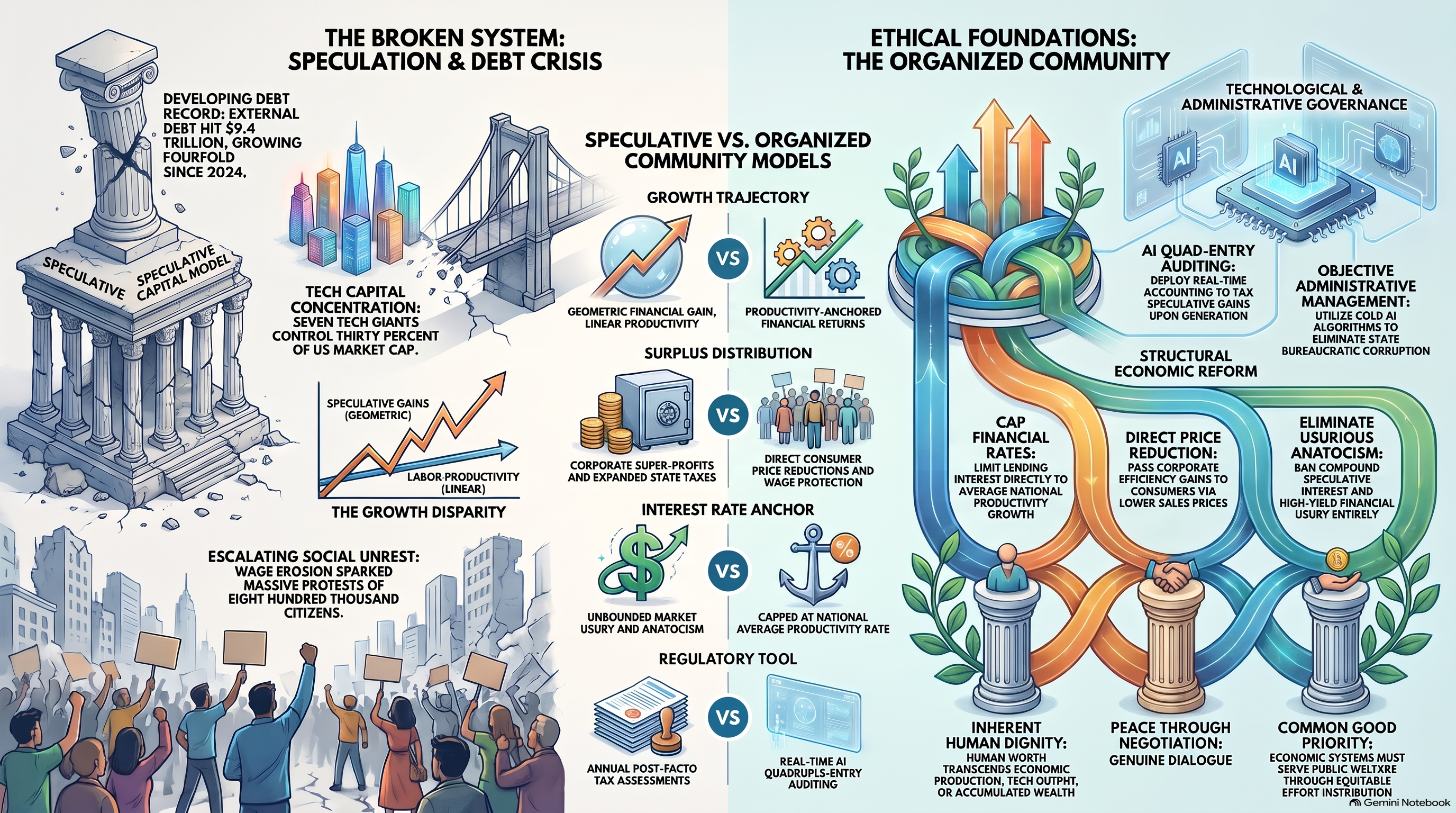
As regards the economization of inputs and productivity, part of its gains should be allocated as an incentive to the economic group that generated them within the economic process. This benefit should serve as the basis for lowering sale prices, as a way of optimizing the marketing process and helping products become cheaper. The aim is to increase domestic consumption and keep companies’ production levels high, with sensible rather than speculative profits. In these cases, I believe the STATE should promote the neutralization of superlative profits and their spillover into wages, given that the spillover of corporate super-profits through lower prices is rarely, if ever, seen.
In this regard, we should consider that today a group of seven technology companies, spanning from hardware to cloud software, has a market capitalization of around 30% of the US economy. This leads us to conclude that their commercial earnings are immense, and so, therefore, will be their net profits. Moreover, in the same vein, there is financial and speculative income from anatocism (interest charged on interest). Hence, these benefits should be minimized when they are generated to be enjoyed by only a few, since such benefits must be tempered when they are drawn from those achieved by the whole Community.
Alternatively, other ways should be sought to reward entrepreneurs who operate with the aim of optimizing production and not merely by manipulating sale prices. The purpose is to maintain and increase the purchasing power of consumers’ wages through stable prices or through cost reductions that can be reflected in sale prices. This can be seen as a new approach to the administration of the State.
The State was created to safeguard the common good and an equitable sharing of the general effort, not to have abusively privileged sectors, niches or groups. Especially when the benefits do not arise from sustained effort but from speculative factors of various kinds, which will be analyzed here.
For only under such a scheme can the effects of inflationary recession be tackled.
This approach demands a change in the tax system. Instead of raising the tax burden as a way of capturing the super-profits taken from companies that profited excessively from prices, profits which the State captures through a bureaucratic process of higher taxation in order to deliver distributive justice through state spending on healthcare, social insurance, subsidies, pensions, etc.
This is different from favoring the economic process by lowering sale prices for consumers and workers, which allows consumption to grow at stable prices and production technology to improve. Here, consumption grows in real units and not in inflated amounts.
We must avoid creating an administrative and bureaucratic super-class within State agencies (something not even Quesnay dreamed of as part of the sterile class) to provide State services financed by ever-increasing taxation on companies’ super-profits. This encourages the bureaucracy to increase State spending without limit, by issuing money or raising revenue through all kinds of taxes, levies and pseudo-fees, which creates niches of inefficient state spending run by bureaucrats. In many cases, these tempt the bureaucracy to carry out maneuvers for its own benefit with the exorbitant funds raised through unusual taxes or levies. Or with worse intentions, bordering on political matters linked to frauds already known to all.
Instead, we must increase production volumes, which lower costs and improve production techniques, and reduce the use of materials in order to lower prices, which increases consumers’ purchasing power. This favors growth in domestic consumption and improves production costs for exports. Any contraction of production generates unproductiveness and higher costs in general, and in particular higher FOB prices for exports, whether through cost increases due to lower production or through tax increases as revenue falls.
Today we face a new challenge that has unexpectedly taken hold and is emerging as the new generator of unprecedented wealth and the optimizer of production and every other activity: the future scientific and economic manager, the excellent and objective intermediary that is already taking shape in the agent called AI.
A governing force that coldly cancels out passions and generates knowledge and action across all dynamics.

Meet Madam AI.
Today you can see AI news presenters developed in China, which speak several languages instantly, are consulted in real time and give accurate answers. It is impossible to detect in them any unreality, poor diction or inappropriate voices, unlike human journalists who have knowledge but handle their performance poorly.
With these preliminary observations, we can continue.
This approach shows the way to put the formation of financial savings in its proper place, arising from healthy sources of productivity.
At stable prices, which from this perspective are the only way to build savings markets that finance the growth of capital goods and real estate. Or State enterprises, which can be managed scientifically, avoiding errors and bad practices.
So that domestic savings plus inflows of foreign capital pass through the financial markets in adequate volumes, through the sound financing of share issues.
Instead of granting expensive loans which, with their interest arbitrage and profit margins, only make planned production, or the national cost, more expensive.
Not to generate savings out of speculative gains on shares traded on stock exchanges for securities and corporate paper, which benefit certain special sectors.
Gains that professional speculators generate as a matter of course.
Trading in assets, shares and other securities should be directed toward non-speculative financing, not toward the benefit of a few who only wish to steal the general benefits.
This position requires a very deep change of mindset in the management of companies, both private and state-owned. It also requires a far-reaching reform to tax, in real time, the harmful gains of certain fields of speculative or unhealthy activity.
Productive investment must be promoted, and high financial rents, speculation and usury eliminated. For savings should not be generated through the extraordinary and speculative commercial profits of the sector that arbitrages financial rents.
To this end, a new business ethic is needed that fosters «technological innovation» and «productivity» instead of «sterile commercial profitability».
In my understanding, the State should not foster speculative rents, gambling, drugs, or the use of means harmful to young people. Such practices should be directly controlled, and their proceeds should not be used as a source of tax revenue.

This system is that of an «Organized Community», the one advocated by the Social Doctrine of the Church in several well-known encyclicals.
In this regard, I invite those who have not yet read the encyclical «Magnifica Humanitas» (The Magnificent Humanity) to consider the principles set out by Leo XIV. SEE:
https://www.infobae.com/opinion/2026/05/24/la-enciclica-del-papa-leon-xiv-la-magnifica-humanidad
There, he sheds the light of fraternal love and a new human and social meaning, which calls for limiting unholy activities, or those that reduce the benefits of all for the sake of a few.
So that you can appreciate a synthesis of the teachings and principles of the encyclical «Magnifica Humanitas», I offer you a summary produced by AI, so that the lofty and pragmatic views set out by Leo XIV can be seen.
Here is the summary:
THE MAGNIFICENT HUMANITY OF POPE LEO XIV
A synthesis of his personality, his thought and his commitment to humanity
Pope Leo XIV is a figure of deep human, spiritual and universal significance. Beyond his role as the highest authority of the Catholic Church, his personality invites reflection on values fundamental to human coexistence: peace, fraternity, humility, justice, solidarity and respect for the dignity of every person.
His humanity should be appreciated not only through his religious role, but also through his way of understanding human beings, their suffering, their hopes and their responsibilities toward others.
In a world marked by wars, economic inequalities, political confrontations, intolerance and deep social upheaval, the figure of Leo XIV takes on particular relevance: he reminds us that the progress of humanity cannot be measured solely by its technological, economic or scientific advances, but also by its capacity to build a more just, supportive and peaceful society.
1. A life shaped by service and human experience
Leo XIV, born Robert Francis Prevost, was born in Chicago, United States, on September 14, 1955. However, a fundamental part of his human and pastoral formation took place in Latin America, particularly in Peru, where he worked for many years as a priest, missionary and later bishop.
This Latin American experience is especially significant. It allowed him to know at first hand the difficulties of communities, poverty, inequality, the needs of families and the hopes of the most vulnerable.
His formation as an Augustinian is also important for understanding his personality. The tradition of Saint Augustine places special emphasis on the search for truth, interiority, love, fraternity and unity among human beings.
His episcopal motto, In Illo uno unum («In the One, we are one»), expresses a deeply humanist conception: differences between people should not become grounds for confrontation, but opportunities to build a human community.
His election as pope on May 8, 2025 also marked the arrival of the first pontiff from the Order of Saint Augustine.
2. Human dignity as a fundamental principle
One of the most important aspects of Leo XIV’s thought is his defense of the dignity of every person, regardless of nationality, economic condition, social position, religion or productive capacity.
Human beings cannot be valued solely for what they own, what they produce or the place they occupy in society. Their dignity is inherent in their very existence.
This conception is enormously important in today’s world, where economic success, political power and technological development often seem to matter more than human needs.
The Pope holds an integral vision of development: progress only deserves that name when it benefits people and peoples, especially those living in poverty, exclusion or vulnerability.
Consequently, a truly developed society is not one that accumulates more wealth, but one in which its members can live with dignity, freedom, education, work, justice and opportunity.
3. Peace as the responsibility of all humanity
The defense of peace is another of the most prominent features of his thought.
Leo XIV has insisted that war is not a true solution to the problems of peoples. On the contrary, it destroys lives, economies, institutions, families and opportunities for development.
His message is addressed particularly to those with political and military responsibilities: rulers must understand that their authority is not an instrument for imposing their will, but a responsibility toward their peoples and toward humanity.
Peace is not simply the absence of armed conflict. It requires justice, dialogue, recognition of human rights, international cooperation and the elimination of the conditions that generate violence.
One of his most significant proposals is to restore negotiation as a fundamental instrument of international relations. Adversaries should not necessarily be regarded as irreconcilable enemies: above all, they are human beings with whom paths to understanding must be found.
This position takes on special importance in the face of international conflicts, geopolitical rivalries, nuclear threats and the growing use of force as a means of settling disputes.
4. Solidarity with the poor and the most vulnerable
Leo XIV’s humanity is also expressed in his concern for those who suffer.
Poverty, hunger, exclusion, forced migration, disease and lack of opportunity are not marginal issues: they are central problems of social organization.
His thought invites us to look at reality from the perspective of those who suffer its consequences, and not only from that of those who make economic and political decisions.
Solidarity should not be limited to feelings of compassion. It must become concrete actions, responsible institutions and policies that make it possible to overcome inequalities.
In this conception, the economy must be at the service of people, and people must not be subordinated solely to economic interests.
5. Technology and artificial intelligence at the service of human beings
One of Leo XIV’s most topical contributions is his reflection on technological change and the development of artificial intelligence.
The Pope recognizes that science, technology and artificial intelligence can contribute extraordinarily to the well-being of humanity. However, he warns that these advances can also generate new inequalities, concentration of power, job losses, manipulation of information and technological dependence.
His fundamental concern is that human beings should not end up subordinated to machines, to algorithms, or to the economic interests of those who control technological resources.
Artificial intelligence can help us think, calculate, research and produce, but it must not replace conscience, moral responsibility, sensitivity, or the human capacity to love and to understand the suffering of others.
In this sense, Leo XIV raises a fundamental question for our time: it is not enough to ask what technology can do; we must ask what we use it for, and for whom.
Scientific progress must be accompanied by ethical and social progress.
6. Fraternity as the destiny of humanity
Leo XIV’s vision proposes overcoming the divisions that separate peoples and individuals.
Humanity needs to recover the sense of belonging to a universal community, in which cultural, political, economic and religious differences are not obstacles to living together.
His proposal of a civilization of love does not mean ignoring existing conflicts and contradictions. It means recognizing that, in the face of them, it is always possible to build solutions through understanding, justice, solidarity and mutual respect.
He also stresses the importance of small everyday actions: listening, helping, respecting, sharing, educating, and avoiding words that humiliate or provoke confrontation.
The true greatness of a person lies not in the power they exercise over others, but in their capacity to contribute to the well-being of their fellow human beings.
7. A final reflection: humanity above all powers
The human greatness of Pope Leo XIV shows itself in his insistence on one essential idea: human beings must remain at the center of every decision that affects their existence.
Politics, the economy, science, technology and institutions must have as their purpose the protection of life, dignity and the integral development of people.
His thought takes on special value in a world where political, economic, social and military imbalances constantly threaten the coexistence of peoples.
Humanity has extraordinary scientific knowledge, immense technological resources and productive capacities never before achieved. Yet it has still not managed to resolve its great contradictions: poverty amid abundance, wars amid progress, intolerance in societies that proclaim freedom, and destruction in a world that needs to preserve life.
That is why the message of Leo XIV is an invitation to recover the ethical and human dimension of progress.
His fundamental teaching could be summed up in one conviction: there will be no true progress of civilization as long as the development of human powers is not accompanied by the development of people’s humanity.
Humanity does not merely need to be more powerful, richer or more technological. It needs to be more just, more fraternal, more understanding and more supportive.
The true greatness of man consists in recognizing the other as a fellow human being and not as an adversary, as a brother and not as an instrument, as a person and not as an object of interests.
In short, the magnificent humanity proclaimed by Leo XIV is a call to build a world in which peace prevails over war, justice over abuse, solidarity over selfishness, and life over destruction.
For the future of humanity will depend not only on how much it is able to conquer, but above all on how much it is able to respect, protect and love.
Key references
- Encyclical letter Magnifica Humanitas, by Pope Leo XIV, May 15, 2026. A document on safeguarding the human person in the age of artificial intelligence. Read the full text on the Vatican website (Spanish version; other languages are available on the same site).
- Official biography of Leo XIV, Holy See. Read the official biography (Spanish version).
Note: This summary covers the main human, social, spiritual and ethical aspects of Leo XIV’s thought, drawing especially on his encyclical Magnifica Humanitas.
We must therefore consider the following.
The external debt of developing countries reached a record US$9.4 trillion in 2025, growing at four times the 2022–24 average and making development priorities more expensive around the world.
Those interested in the details of this debt can find them here:
This indebtedness shakes the poor countries, which must still bear interest payments in order to survive in the world of the RICH GIANTS OF THE WORLD.
THEN:
Merchants, and even some Catholics, are dazzled only by wealth and speculative gains, dreaming of the pleasures of this world, which never manage to satisfy them. They are so blinded that they do not realize they will not take the money socially stolen with them in their shrouds.
Although the grassroots of the popular will delegate the management of the productive economy to entrepreneurs, the process and the results achieved by the economy are not controlled so that the benefits are shared among all.
This is an old vice and ineptitude in the criteria of tax policy, which treats those who fulfill their social duties the same as speculators, who have no other way of thinking than of their own or their group’s well-being. As happened with Banco Ueno in Paraguay.
An aspect that links the lack of control at the highest level of State power with speculation that uses public money to defraud the popular majorities.
Those who contribute financial savings to the productive system should be rewarded with a premium set with the general productivity of the system as its limit. This should be taken as the maximum premium relative to the average interest rate on loans.
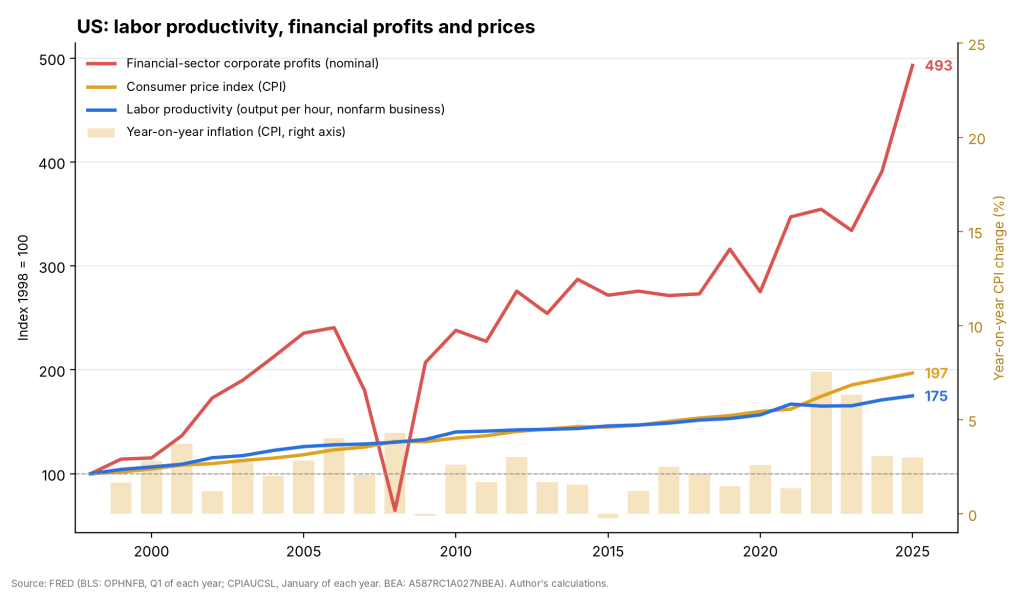
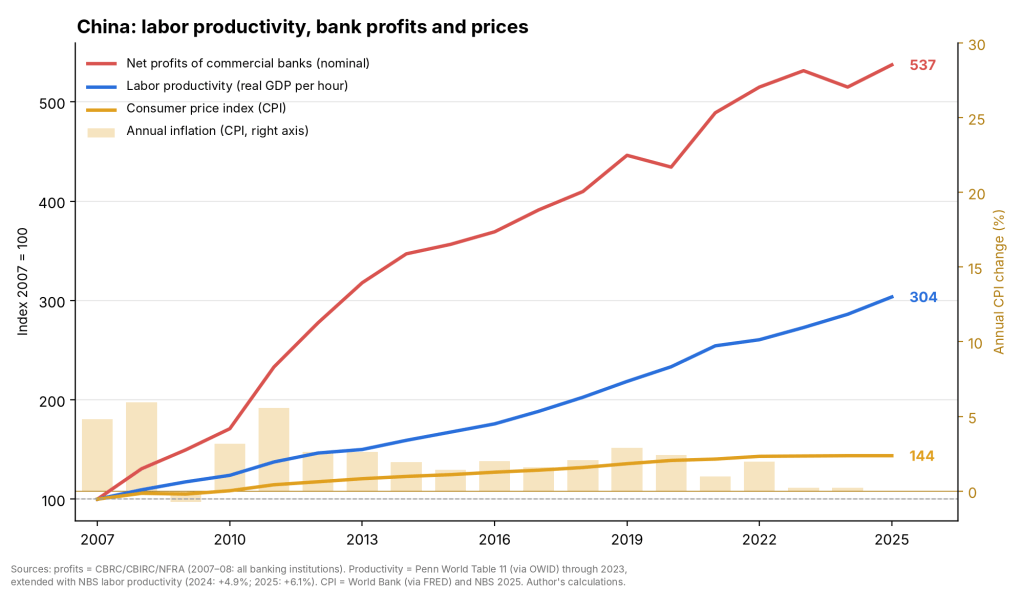
The following chart shows that financial and speculative gains grow geometrically while labor productivity grows linearly in the US. Since financial rents and speculation are absorbed out of productivity, in order to keep withdrawing these funds from wages and other incomes, employees’ pay must be cut, which feeds the growth of inflation. These withdrawals, in turn, reduce consumption and generate recession. Recession thus combines with the inflation it generates, and this process continues unstoppably over time, until it reaches hyperinflation, which drags economic dynamics into a final recessionary process requiring a global crisis, from which the process of readjusting the economy begins again. It is with this criterion that we must think about the measures to be adopted to stabilize the economy, in order to reverse the vicious process of stealing productivity gains to pay financial rents and speculation. The chart also shows, as bars on a second axis, the change in the price index. There is a 25 percentage-point gap between labor productivity and the final price index.
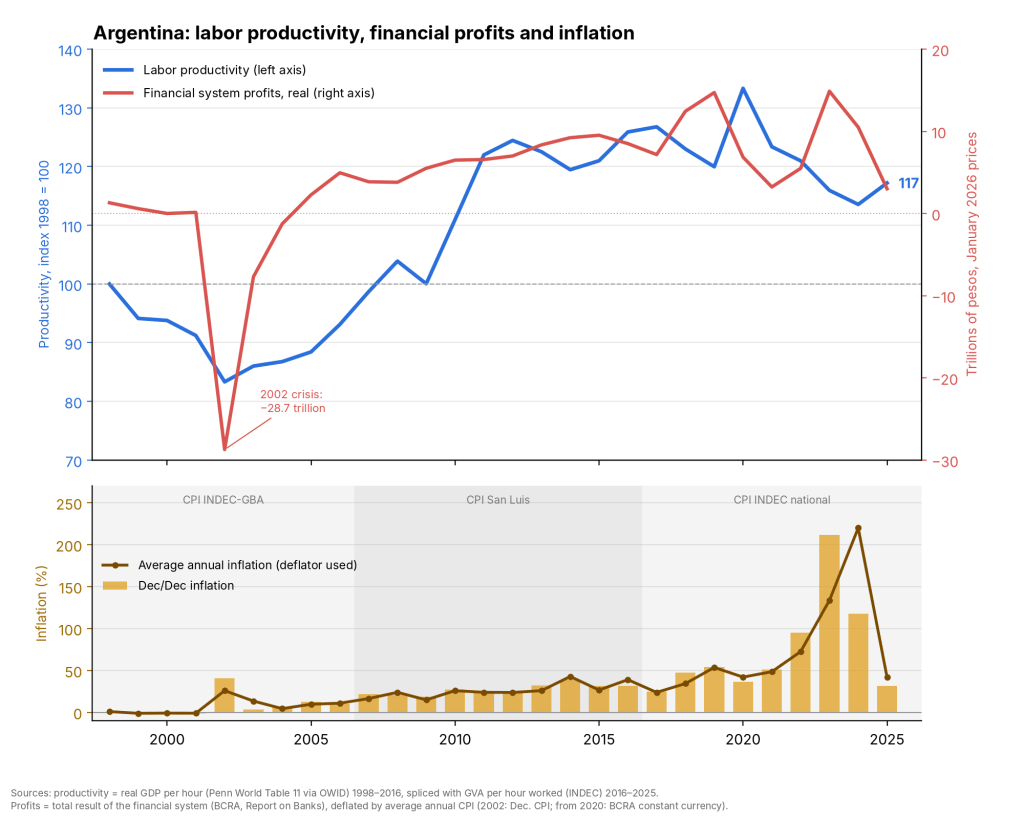
The same analysis can be seen for Argentina. Unlike the US, there is stagnation both in productivity from 2011 onward and in financial corporate profits. This is due to the high inflation rates suffered since 2009, which have exceeded 40% a year since then.
As a third scenario, we show a similar analysis for China. Here inflation has been falling steadily for a long time, and this is reflected in the growth of labor productivity, which in turn has increased the purchasing power of wages. Likewise, the reduction of the combined effect of inflation-driven recession has resulted in higher purchasing power of wages and higher consumption.
Finally, we present the actual debt-service burden of Argentine households as measured by the Central Bank of Argentina (BCRA) from 2023 to the present, together with an estimate for the preceding 10 years using a similar methodology.
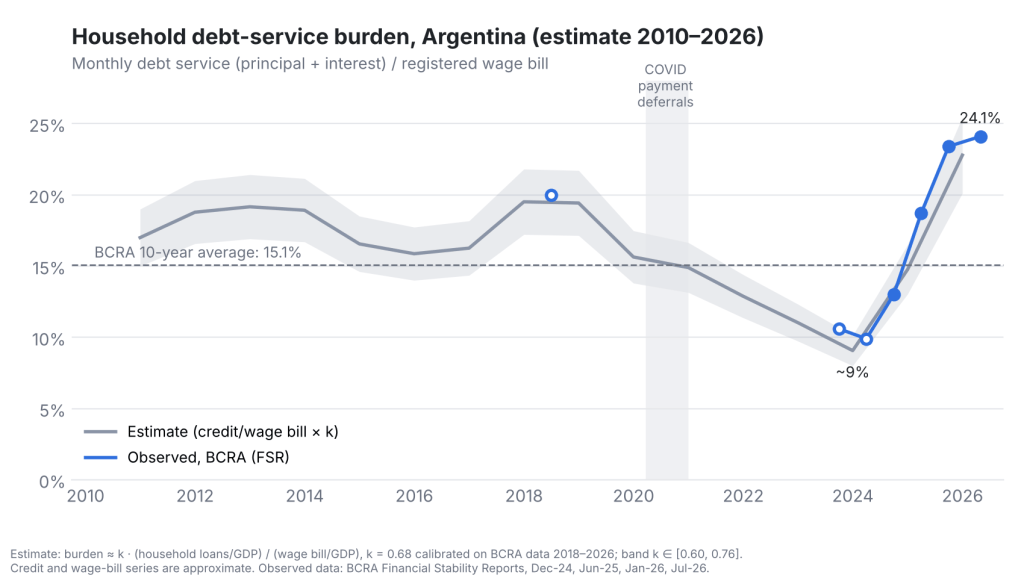
These show that the financial burden, in general and for households in particular, is severely eroding purchasing power because of the weight of financial costs in consumption. This points to the need to prevent usury from being the beneficiary of the use of financial capital. Today, in some cases, total financial costs passed on to consumers reach 500% to 800% a year (see article, in Spanish):
Because no one may impoverish citizens beyond what they earn from production.
Without normal sales and production, no profitability is possible.
The system must allow financial supply to adjust to demand, seeking in the long run that the rate of productivity is not lower than the interest rate of the financial system. This should be induced through a procedure that aligns lending rates with the average rate of domestic productivity of the national economy and with deposit rates.
No one may impoverish the ordinary saver by paying interest below the recovery of the currency’s purchasing power. That is, practicing the theft of money’s purchasing power relative to the price levels of the goods consumed by most of society.
ONLY THIS IDEOLOGY CAN BE CARRIED OUT THROUGH STABLE PRICES THAT ADEQUATELY FINANCE THE PRESENT.
Through a procedure in which interest on lent money is charged on the criterion of not generating pathological imbalances in financial intermediation, rather than through the indexation of capital plus interest at speculative financial rates and the application of perverse anatocism. A system in use that accumulates and disorganizes the order and valuation of variables relative to one another, where few win and many lose their income and a reasonable standard of living.
If all countries join together in finding the path of productivity instead of the speculation of excessive commercial and financial profitability,
then the world will move toward making the world economy work in harmony with, and in reward of, productivity, and not through economic and financial cancers.
Banks and financial institutions must report the financial rates applied to their operations and those planned for future offers.
The aim is for investors to know, through these publications, the transparency of financial markets and the democratization of a system that requires permanent oversight, in line with the sound principles of disclosure that underpin transparency for both the saver and the borrower.
Accordingly, the Central Bank must ensure that average interest on all loans does not, in general, exceed the average rate of national productivity.
The average productivity rate will be determined by the national statistics authority, taking into account the productive profitability of the nation’s companies.
This will prevent the creation of unproductive businesses that benefit classes enriched by usury and speculation to the detriment of other classes, so that the purchasing power of consumers, in their broad base of wage earners and retirees, is not affected.
This is a State policy that should be adopted immediately by the countries of the world, seeking peace and unity within each individual country, which is the only way to integrate the world peacefully into a single WHOLE.
This union and peace agreement, which seeks the social justice of the encyclicals of the Catholic Church, is the basis for forming the supportive Organized Community.
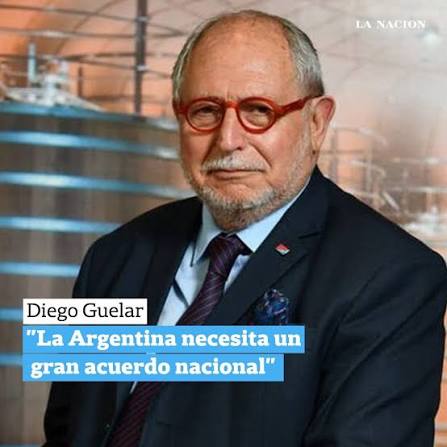
It should be enacted by a majority of the Legislature for the benefit of the whole community. I believe this law should be one of the essential points of the NATIONAL AGREEMENT to be implemented in Argentina as soon as possible.
This will ensure that the incentive for capital to invest is directed straight to ventures with high productive results thanks to their technology, and not to arbitrage of capital received for speculative purposes, which must be definitively eradicated from social, productive and commercial ends, as order and social justice require.
Speculation, gambling and anatocism, as vices, increase investment and spending, especially when they are in the hands of the State. The State should not take part directly in these activities. They should not be used to raise taxes, nor should their profits be awarded to promote private rents. Gambling addiction creates psychological dependence and serious pathologies that affect society in general, and its mass promotion undermines public order. Moreover, it tends to increase spending on the justice system, prisons, etc., required by gamblers who break the law and commit crimes. All this in a world that steers young people toward gaming and gambling as a way out of depressed incomes.
I knew the times when there were no more than two casinos in Argentina, and none of the so-called slot-machine halls full of addicted citizens. Neither slot machines nor devices of temptation for playing individually and personally with frenzy and a spirit of personal salvation.
Those were the years when people aspired to salaried work with social benefits.
Only a productive economy with strong earnings can repay high financial interest, and even then the results will not always be positive for society in general, unless the cost of money stays within reasonable limits for financing national production.
But it is better for profits to come from productivity, and for productivity to spill over into wages and other agents through price stability or falling prices.
Especially when they are sustained by conduct guided by efficiency, productivity, savings in consumption and the improvement of ecological conditions, as a business psychology for one’s own benefit and that of the community in general.
These aspects are discussed in great depth in the encyclical Magnifica Humanitas.
In other words, to achieve the optimal spillover of business profits in order to reduce the ad valorem taxes levied on sales, so that these transactions benefit consumers in general. Instead of having to raise taxes to finance State spending that grows because of price increases driven by business speculation, along with the rise in social costs due to heavier taxation and the benefits of bureaucracies.
Then there is the lack of free markets with adequate competition, markets instead run by organizations that deal in the carving up of territories and other expedients.
If analyzed, the prices quoted in State procurement are always rising, especially in periods of stagflation, and these increases are masked by inflation, which disrupts stable prices, making them useless for monitoring contract awards.
This approach buries the short-sightedness of promoting populist practices which, under such conditions, constantly increase budget spending items and consequently force higher taxation to finance them. This tempts the bureaucracy to intervene through its participation in these processes, generally taking personal or group benefits from spending and investment processes. Not to mention worse practices.
Only the individual has the possibility of profiting from his personal services to sensibly maintain the value of his money, up to a certain point, when usury and speculation are applied in exorbitant amounts.
But when the activity rests on the contribution of collective work and the use of the means of production, excessive profitability must be reduced through taxation that withdraws speculative financial rents effectively at the time they are generated, not at the time of annual tax returns. To this end, a national AI-based information system should be created which, through a quadruple-entry accounting method, sets up a process that withdraws speculative gains immediately when such financial rents are collected, so that speculation does not spread its effects into other fields. Directly and on an ongoing basis.
In line with the criterion that speculative financial excess should not keep earning more money that is withdrawn from the productive circuit that needs it.
This policy must be combined with the control of deviations and speculation arising in the movements of the trade balance, the financial and banking accounts, etc., in order to continuously achieve stability of economic variables and maintain normal financing for companies and consumers. Especially when financial rates exceed their normal levels and lead to the accumulation of debts that are unsustainable not only for private parties but also for the State. Both cases generate serious pathologies in price formation and in the chain of payments.
A situation that can be seen in Argentina and in other countries.
The money needed to finance society’s real and necessary expenses must not be stolen as the sole expedient.
No nation can progress by promoting capital lured by high speculation, nor «swallow capital» (hot money) that makes usurious profits and then leaves the national economic space, taking with it fortunes not controlled by the governments themselves or by the institutions that direct national financial flows, in many cases the central banks.
Still less by encouraging imports that generate profits for foreigners, destroy the national productive apparatus and promote systemic unemployment. The destruction of the national productive organization is encouraged by those who want to enter other countries with subsidized costs and who, once inside, hardly compete with anyone.
They destroy the industrial and technical organization built through investments made by our forebears so that their grandchildren could carry it on.
Nor is it positive to generate enormous profits that are transferred abroad through financial, tax and exchange-rate maneuvers arising from the handling of imports or exports, through the repatriation of profits disguised as interest financing foreign operations, or that repay and conceal royalties or other benefits within the costs of these transactions.
Or interest charged in advance on imports, used to make products with high costs and excessive FOB values. Or disproportionate and inappropriate royalties transferred through inflated import payments.
Not all the procedures of speculation and usury are well known to textbook economic theorists. Some who know these practices can assess the systemic and habitual evasion that drives money out of countries in a systemic and habitual way.
This approach will result in higher incomes for the groups that strive in production or services, to the extent that the latter achieve productivity and economization.
Let us note that today the advantages of a pure economy of free and competitive markets based on productivity do not exist; instead, the economy is tied to price increases generated by stagflation and the high financial interest associated with it.
In this way, there would be no need to keep levying taxes for general revenue through inflationary or technical revaluations (of land, industries, farms, factories, etc.), which undermine the formation of productive capital.
For real social benefit can only be generated democratically in the productive cells of the economy, through lower production costs and lower sale prices. This is the natural and simple way to increase the purchasing power of incomes, salaries, etc., earned through the effects of productivity and economization.
In particular, central bank policy should use the easing of credit and of minimum reserve requirements to accompany and cushion recessions and promote growth, generating funds to encourage and promote the use of capital for national development. This could be done through long-term policies promoting areas or products needed for lasting future development. Not as has been done in the past, by wiping out production in the country’s interior through violent changes in the exchange rate, the withdrawal of bank loans, and the cancellation of tax rebates and drawback.
These have systematically demolished many attempts to produce and sell provincial products through export promotion. Policies that governments have applied repeatedly.
From another point of view, raising export duties in order to play with cash balances and bank reserves in the oversized financing of government debt at its various levels must be described as criminal and as an attack on the national productive system.
The world is hungry for food, fuel, rare earths, technological services and products, entertainment, and efficient and cheap payment and financing systems. These mark out fields of investment that are necessary and more in demand every day.
It should not be possible for financial institutions to grant credit so that resellers can buy production at the plant, on the farm, etc., at rock-bottom prices and make better profits to the detriment of producers. This is speculative capital for buying harvests, cattle in lots, etc., offered to resellers of production before the harvest.
This translates into additional inflationary or abusive prices, generating inflationary profits that undermine the value of the currency and the purchasing power of wages. It must not be encouraged by raising the interest rate on certain operations (bank consumer loans, investments, rediscount rates, speculative operations, repos, secured loans, etc.) that harm national consumption or create vicious indebtedness among social classes. Especially when bank and financial delinquency rates are very high and widespread, because in such situations the chain of payments breaks down, as perverse as it is antisocial. This is not fixed by the same people who generate the usury. Usury that has already been booked and continues to be lent for the same purpose.
Under these conditions, markets cannot resolve the inconsistency and incongruity of the effects generated by stagflation, owing to the perverse mechanism that lashes the economy with inflation, which undervalues the income of the whole community and raises prices while lowering the physical levels of production. In this dynamic, costs rise because of the high and perverse idle capacity, which is passed on to sale prices, perpetuating the effects of continued recession.
This forces layoffs and cuts in work shifts that reduce national income, with falling regional and national consumption according to their impact. As production falls in quantitative terms, the supply available for export shrinks, which raises costs.
The approach of encouraging microeconomic results (productivity, economization) to be passed on to prices requires a new vision and a system of rewards and penalties in business dynamics, to encourage the spillover of increased purchasing power to the popular consuming classes when such results are achieved.
Those who bring prices and costs down in the business sector, spreading business productivity, should be promoted. This guarantees the evolving stability of all operations, whether business, consumption, social, etc. Spillover to prices can also be encouraged through tax incentives, when this spillover actually takes place in time and space.
It must be understood that financial operations are tied to speculative markets in broad sectors of the world economy, and these must be curbed. In particular, a global information system should be built that includes all financial centers or tax havens that finance illicit enrichment from strange and impure sources. The profits derived from all sources must be made public in order to bring them into the open and prevent the flight of money that fuels illicit operations in drugs, human trafficking, organ trading and sales, and fraud by public officials, which create inequities and a class of beneficiaries who hide from justice and from fair social distribution.
We must also formulate a new stability based on eliminating the weight and arbitrariness of the forces that move financial power for sectoral benefit. If we assume that this power grows permanently, we must redirect its function toward a social purpose.
One in which unhealthy speculation is prohibited and punished.
In this regard, it should be noted that the framework of financial usury associated with the free issuance of currencies must be stopped and not financed with rising interest rates, as can be seen in the undue growth of debts arising from anatocism.
The practice of excessive borrowing without specific purposes can be seen in the way financial statements were prepared in Sweden, at the time when I worked on them. First, in the presentation of balance sheets, debts are shown at the top. These are what create the burden of future payments and reveal the excess liabilities that are not channeled into productive investment.
They explained to me that liabilities must be presented first, to show the amount of debt taken on, which is only justified when it finances productive assets.
The usurer’s policy takes part of the profits of businesses and of members of society, causing a loss of purchasing power for the other, majority social classes. A situation that is unviable for a society when this practice becomes commonplace.
This will continue, and late in the 21st century it is manifesting itself in the consequences we are living through today. A present aggravated by rising fuel prices due to shortages of supply, since fuel is indispensable in today’s technological world. This is bankrupting consumers in importing countries with high costs, as well as producers who cannot ship their output from production and refining sites because of war and areas occupied by mines and other attacks. As in Hormuz.
When oil conflicts arise, countries that possess oil are attacked and their producing wells seized, or the president of an oil-producing nation is captured and tried in courts that are not his natural jurisdiction. Political leaders of States should only be tried in their own nations, where they exercise their political power.
Oil-producing countries are invaded militarily, as in the case of Libya, where some kept that country’s deposits in foreign banks.
What do international institutions say in such cases of theft of funds belonging to countries driven into disorder and bankruptcy?
For me, the most paradigmatic case was the destruction of Yugoslavia, brought about by pitting against each other different ethnic groups that had built an organized nation.
Do you know who instigated this assault on a non-liberal democracy in Europe?
It was one of the largest States in the world today, according to a director of one of Yugoslavia’s private banks, who confided to me how they brought about Tito’s downfall.
The use of tax havens should be denounced by the IMF and other international bodies. In general, the countries of the world should publicly declare their repudiation.
This is the only way to bring honesty, promote business ethics and prevent the growth of the world’s usurious capital. Which exists. Yes, a great deal of it, and in it shelter all kinds of criminals who run the illicit businesses that tear apart the social organization of countries. These bodies are responsible for tax evasion in countries.
We must consider mistaken the policy upheld by the Trilateral Commission, which advocates the privatization of state enterprises in developing countries as a way of repaying debts.
Nor should we justify the collection of debt plus exorbitant interest, legal charges, etc., pursued by foreign holdouts and holding companies that buy debts for a pittance at derisory values in order to make speculative profits through later court rulings for incalculable payments.
Even if the principles of national and international commercial law justify such operations, carried out by banking specialists through holding companies and tax havens and protected by judges whose views are the cold and hidden views of spurious business.
Let us not forget that the interest and principal owed are paid by the State, but that these funds ultimately come out of taxpayers’ pockets, today or tomorrow. As always.
Therefore, the capitalist world, the US government and the countries tied to the dollar must understand once and for all that there is only one way to reduce the imbalances of the international financial system and avoid the speculative drive that benefits some to the detriment of the rest of the world.
When the economic incentives of capital can be aligned to take part in the unavoidable development of underdeveloped countries, allowing them to be integrated into the world. This can only be achieved through agreement among the great powers; this is possible.
Otherwise, wars will continue as always.
In order to pursue the premise: «REDUCE THE USURIOUS INTEREST RATE OF FINANCIAL CAPITAL».
With the aim of lowering international production costs so that humanity as a whole can progress. Just as D. TRUMP demands of the US Federal Reserve, in order to lower the cost of transactions and halt the effects of the stagflation that is already affecting the American population. Pure nationalism.
In this case, to protect and expand the output of US companies and to avoid the weight of mass imports of products from China and other Asian countries, which is making American companies tremble.
US nationalism remains as it was at its beginnings, when it would not allow goods to be unloaded from ships that did not carry bills of lading from their countries of origin.
Thus, ethical concepts must be reordered for a rational distribution of economic productivity among all the countries of the world, through the application of concrete rules for the benefit of society as a whole.
The operation of companies must be optimized and cared for within a global order. Not with the mere criterion of creating mega-corporations, with the aim of forcing the closure of existing companies that create jobs for the world’s citizens in a practical and social sense. The process of reorganizing the national and global productive order must not be paid for by the brutal suffering of the working classes in a single, painful present.
Only the passage of time will allow the rational optimization of all companies without the lethal effects of mass unemployment and uncontrolled stagflation.
This is something that the rationalists or anarchists who wish to destroy the existing order, which provides work and social order for the worker, the family, and the national and international order, must understand.
Many believe in the fantasies of «adjustment now», which only leads to hardship.
In this way, the stability of national and international prices can never be achieved. We must understand that global business efficiency will be born over the long time of habit, in the rational and voluntary search for ever-increasing efficiency and productivity and the elimination of the unhealthy speculation of current practices. Theory is a long-range goal; the present is forged with the errors of current circumstances and shortcomings. The statesman works prudently between the two goals, in order to keep moving forward with growth, without end.
Never to finance recession, nor to punish national consumption, nor to annihilate the public spending necessary for the benefit of society in general.
This situation, and not the fictional theories of destabilizing the world’s companies in pursuit of global efficiency, is the path for society. Present-day utopias, in line with anarchist idealizations, are costly for many. Global efficiency can only be achieved in rational and humane timeframes for society. Efficiency that destroys the established order must not be achieved through the present anarchy of national economies.
The order of AI is coming by leaps and bounds and is as unstoppable as the Industrial Revolution. This state will be reached over time, jointly with the new AI workers. Not by human beings through traumatic processes, but when other means of distributing national income are required, based not on payment for man-hours worked but on other parameters.
We can characterize this fact as the «peaceful revolutionary phenomenon of the organized forces of the world’s supportive community for the 21st century» through the effects of AI, which requires a complete reorganization of current rights and procedures.
This is the outlook that would allow the benefits to be shared among all, without generating crises or global recessions combined with the simultaneous inflation and recession now spreading throughout the world. The world’s economies can only improve when the wars destroying the world order are halted and speculation, drugs and global disorder are wiped out. Such as acts of piracy when lands of other countries are seized, or when there are attempts to annex the oil lands of other countries by turning them into a new governed district of the US, without a legitimate popular consultation of the citizens of the country to be absorbed, as if they were a mere economic asset.
When the effects of these dynamics can be extended to promote the development of stagnant countries, a new world order can be achieved, associated with the stability that generates progress.
Only through progress and order can global order and stability be maintained.
Only a world that is a fraternal community, far from violent and grave speculation, can evolve in peace and without speculation. Without dishonest administrators, the order and peace dictated by the encyclicals of the Church, and especially by the spread of the contents of «The Magnificent Humanity», can be achieved.
Allowing the benefits achieved by rich societies to be extended to all the nations of the world in the civilization of the 21st century.
Otherwise, we must expect class struggles to spread around the world, creating a negative social imbalance.
Today we already see certain countries, through force and speculation, destroying productive territories and fuel supply areas for the community.
At little cost in human lives.
Very different from the wars of the last century in Europe, which left millions dead and maimed.
Today’s war destroys infrastructure and housing on an unheard-of and very costly scale, bringing pain and hardship to millions of human beings for a long time. For now, they are condemned to live in the precariousness of tents and subsidized supplies.
The «organized community of the world» must understand the new order as one that does not promote or usurp territories to obtain the benefits arising from the occupation of land, as in the case of the Malvinas (Falkland) Islands, the regions of Ukraine, etc. Situations that later lead to new conflicts.
Actions driven by the seizure of land in wars and the devastation of areas that impoverish and expel their native inhabitants, where newly bought, usurped or conquered spaces would be integrated into systems as in the world’s past, but in styles less bloody in lives than when people killed each other face to face.
Nor through the devastation caused by fishing in other countries’ maritime territories, with factory ships operating without paying taxes, or taking the catch through piracy without compensation.
International congresses should analyze and evaluate new ways of distributing the social product among nations. Not only through financial advantages tied to the benefits of the terms of trade, currency devaluations, market regulations, etc.
Avoiding the short-sightedness of inappropriate procedures that uphold unrestricted property according to extreme liberal principles, which take into account neither the ecological order nor the benefit of societies.
Only the growth of production in all the countries of the world together, generating the necessary financial means and means of payment, will allow international trade to grow, on the basis of multilateral payments among them and the industrialized countries. Without seeking the benefits of speculative arbitrage as the sole condition of negotiations.
It is futile to persist in maintaining a scheme that centers the motivation of economic activity on «commercial profitability of business alone» or on the benefits of speculation directed toward certain sectors.
For usurious interest, rising inflationary spending, speculation by intermediaries, etc., have the negative effect of a continuous decline in production, which increasingly promotes idle production capacity. They also increasingly drive military spending, bureaucratic spending, etc., which, once included in the costs and sale prices of products, will make those who live on labor income ever poorer, in the wages and incomes of the world’s inhabitants.
Today, several countries such as France, Spain, Italy and Portugal are erupting in unrest and protests over the lack of funds for students and the excessive increases in the cost of fuel, food, etc.
The street demonstrations that broke out on a strange day, 10/17/26, in Paris and other cities continue without end.
Some 400,000 citizens are taking part in daily protests and uprisings, which has led to the mobilization of 70,000 law-enforcement officers: an army the size of one in the Second World War.
France’s CGT union estimates that the protesters numbered 800,000 across the country.
These protests spread from Spain to Albania. The October 17 movement was the driving force behind the mobilizations against the current status quo, a group made up of united students, trade unions and other allies opposed to the wars.
These situations are due in particular to the erosion of wages, which defunds the social and family order. The demonstrations have turned violent, with various public and private buildings set on fire, going beyond the normal bounds of protest. This has led E. Macron to impose a curfew. An extraordinary situation for a country that is a cradle of democracy.
The current effects of war and anarchy are expected to spread unless solutions such as those suggested here are found. We must understand that the anachronistic measures used by economistic mechanisms have failed over time, and these measures seem like aspirin to cure cancer.
These are my proposals, analyzed and thought through not on the basis of purely monetary and financial recipes, nor as declarations of utopias or ideological positions.
I hope no one is offended, and that these words help to rethink and temper the haste of the many who think only in terms of traumatic scientism.


